
Commercial exercise bike with fan: difference from home models - factories
2026-08-22
- Why a commercial exercise bike with a fan is not just a “big home”
- Design differences: frame, load and durability
- Cooling system: fan as part of the engineering system
- Electronics and Data Accuracy: Why It Matters for B2B
- Risks of purchasing from unreliable factories: market experience
- How to choose the right manufacturer: a checklist for the buyer
- About the manufacturer: Shandong Jianzhixing Industrial Technology LLC
- Frequently Asked Questions
Why a commercial exercise bike with a fan is not just a “big home”
In our practice of supplying equipment for fitness clubs, we regularly encounter the same mistake of buyers: an attempt to save money by purchasing household models for commercial use. The result is predictable - failure of the bearings after 3-4 months of intensive use and loss of the club’s reputation.Commercial Exercise Bike with Fanfundamentally different from home analogues not only in price, but also in the engineering philosophy embedded in the design. If a home exercise machine is designed for 3–5 hours of work per week, then a professional model should withstand a load of 12–16 hours a day, 7 days a week.
The key differences lie in the cooling system and frame design. The fan in commercial models is not just an accessory for user comfort, but a critical thermal management element of the drive system and electronics. Manufacturing factories in China such as our companySHANDONG KINGSTAR SPORTS FITNESS CO.,LTD,, design these devices to ISO 9001 standards and EAC/CE certification requirements to ensure safety and durability. In this article, we'll break down the technical nuances that differentiate factory-built commercial equipment from consumer equipment and explain why choosing the right supplier directly impacts your return on investment (ROI).
Design differences: frame, load and durability
The first thing an engineer pays attention to when accepting a shipment of goods is the weight and geometry of the frame. Home exercise bikes often use thin-walled pipes with a diameter of 25–30 mm with a wall thickness of 1.2–1.5 mm. Commercial models intended for hotels, corporate gyms and fitness centers require the use of steel with a wall thickness of 2.0 to 3.0 mm. This ensures stability of the structure with a user weight of up to 150–180 kg.
We conducted crash tests on our production lines. The household model, with a dynamic load of over 120 kg, began to make squeaks already at the 500th load cycle. The commercial series, reinforced with double welds in areas of maximum stress, withstood more than 50,000 cycles without deformation. It is important for the plant to understand that if you order equipment in bulk, you must require the supplier to provide metal fatigue testing reports.
Another important aspect is the fastening system. Home models often use plastic plugs and simple bolted connections. Commercial equipment uses hidden fasteners and reinforced anchors to secure the exercise machine to the floor. This eliminates vibration, which is the main cause of destruction of electronic display components. One of our clients from Moscow experienced massive failure of consoles precisely because of the lack of rigid fixation to the floor in a high-traffic room.
When choosing a supplier, be sure to check the class of use of the equipment according to EN 957 standards. Commercial exercise bikes must comply with class HA (High Activity) or S (Studio). If the factory offers you a class H (Home) or even HB (Light Commercial) model for a full-fledged fitness club, this is a direct violation of the manufacturer’s recommendations, which will void the warranty.
Cooling system: fan as part of the engineering system
The term “fan exercise bike” can be misleading. It's not just about the air flow directed at the athlete. In professional models, the fan is integrated into the cooling system of the flywheel and generator (in self-powered models). During intense training, the temperature inside the case can reach 60–70°C. Without effective heat removal, the lubricant in the bearings loses its properties, and the electronic boards overheat.
In our factory tests, we compared two configurations: with passive cooling and with active turbine airflow. The model with an active fan showed a decrease in the operating temperature of key components by 15–18°C. This extends the life of the lubricant by 40–50%. For the business owner, this means cutting maintenance costs by almost half.
In addition, the fan creates resistance. In aerodynamic models (air bikes), the resistance is proportional to the user's efforts: the faster you pedal, the stronger the air resistance. This provides an infinite progression of the load, which is impossible to achieve with magnetic home exercise machines with fixed resistance levels. However, in classic commercial bicycle ergometers, the fan serves precisely for cooling, and the resistance is created by an electromagnetic system.
It is important to distinguish between the type of fan. Cheap analogues use axial fans with low static pressure. Professional factories install centrifugal turbines that are capable of pushing air through dense filters and radiators of the system. When requesting a quotation (QP), always ask for cooling system specifications: fan motor type, air flow (m³/h) and noise level (dB). The noise level of a commercial exercise machine should not exceed 55–60 dB at maximum load, otherwise it will irritate gym visitors.
Electronics and Data Accuracy: Why It Matters for B2B
Home exercise machines often suffer from inaccurate heart rate and power readings. An error of 10–15% is invisible to a home user. However, for a commercial facility where clients monitor metrics, this is critical. Professional cycle ergometers must meet the accuracy standard Class A or Class B according to DIN EN ISO 20957. This means that the power measurement error does not exceed 50 W or 5% (depending on the range).
Factories aimed at exporting to Russia and Europe install sensors based on high-resolution strain gauges. We calibrate each device before packaging. If you are purchasing a batch of 10 or more, request calibration certificates for selected units. The absence of such documentation indicates that the plant is skimping on quality control.
Software integration is another key differentiator. Home models rarely have open data transfer protocols. Commercial exercise machines support FTMS (Fitness Machine Service) protocols via Bluetooth BLE and ANT+. This allows them to be connected to virtual reality screens, club management systems (CRM) and applications like Zwift or Kinomap. For a modern fitness club, the ability to synchronize client data with his smartphone is a competitive advantage.
Pay attention to the power source. Commercial models with a fan are often equipped with a self-powered system. A generator built into the flywheel converts mechanical energy into electricity to power the console and fan. This reduces operating costs and simplifies installation: there is no need to connect sockets to each exercise machine. However, such systems require more complex electronics, so a CE or EAC certificate for the control unit is mandatory.
| Characteristics | Home Use | Commercial Use |
|---|---|---|
| User weight (max) | 100–120 kg | 150–180 kg |
| Operating mode | Up to 1 hour per day | Up to 20 hours a day (24/7) |
| Frame | Steel 1.2–1.5 mm, prefabricated | Steel 2.0–3.0 mm, welded, reinforced |
| Cooling system | No or weak airflow | Active turbine system, integrated with drive |
| Power Accuracy | ±10–15% | ±5% (EN ISO 20957 standard) |
| Warranty | 1–2 years (often limited) | 2–5 years for frame, 1–2 years for electronics |
| Certification | Basic security | EN 957 Class HA/S, CE, EAC, GOST |
Risks of purchasing from unreliable factories: market experience
The Chinese market is oversaturated with offers. On Alibaba you can find thousands of factories offering “commercial” exercise machines at the price of home ones. What's the catch? Often such factories use refurbished (refurbished) motors or cheap analogues of NSK/SKF bearings. Externally, the simulator looks massive, but inside there is savings on every screw.
We have seen cases where, after six months of use, the paint on the frame began to peel off due to a violation of the powder coating technology. Sweat from athletes contains salts that quickly corrode poor-quality coatings. Real commercial plants use multi-stage metal processing: degreasing, phosphating, priming and then applying polyester powder paint with a thickness of at least 80-100 microns. This provides resistance to corrosion and abrasion.
Another risk is logistics and spare parts. If the plant does not have a spare parts warehouse in your region or does not keep safety stock in its warehouse in China, equipment downtime can last for weeks. Ask your supplier for a list of recommended spare parts (spare parts list) and terms of their delivery. A reliable manufacturer will offer to include a set of critical components in your first order: belts, bearings, display boards.
Also pay attention to the packaging. A commercial exercise machine weighs from 40 to 80 kg. Standard cardboard will not withstand sea shipping. Reinforced five-layer corrugated packaging with foam corners and wooden frame is required (if required by customs). Damage to cargo during delivery is a common problem when working with newcomers to the export market.
How to choose the right manufacturer: a checklist for the buyer
Choosing a partner plant is a strategic decision. Don't just look at the FOB price. Look at the total cost of ownership (TCO). Here are steps to help you weed out unreliable suppliers:
- Certificate verification.Request valid CE (for Europe) or EAC/GOST (for Russia and CIS) certificates. Check their number in the registers of certification bodies. The presence of an ISO 9001 certificate at the plant confirms that they have built a quality management system, and not just a successful batch of goods.
- Production line audit.If the order volume exceeds $50,000, we strongly recommend a video audit or personal visit. Pay attention to the welding area: there should be robotic welding machines to ensure uniformity of the seam. Manual welding is acceptable but requires highly skilled operators.
- Test sample.Never place a large bulk order without purchasing a sample first. Test it under conditions close to real life: run it non-stop for 48–72 hours. Check the heating of the motor, the stability of the Bluetooth connection and the noise of the fan.
- Conditions of warranty and after-sales service.Clearly state in the contract the conditions for replacing defective parts. Who pays for shipping? What is the response time for a complaint? A good factory provides a 2-3 year warranty on the frame and 1 year on the electronics, and also provides online technical support.
- MOQ and production time.Check the minimum order quantity (MOQ). For commercial models it is usually 10–20 pieces (20ft container). Production times can vary from 25 to 45 days. Take this into account when planning to open a club.
About the manufacturer: Shandong Jianzhixing Industrial Technology LLC
Our companySHANDONG KINGSTAR SPORTS FITNESS CO.,LTD,, is based in Rizhao City (Shandong Province, China) and has been specializing in the design and production of advanced sports equipment since 2000. Spanning over 60,000 square meters, we combine engineering expertise and advanced manufacturing capabilities to create premium equipment that meets international safety standards.
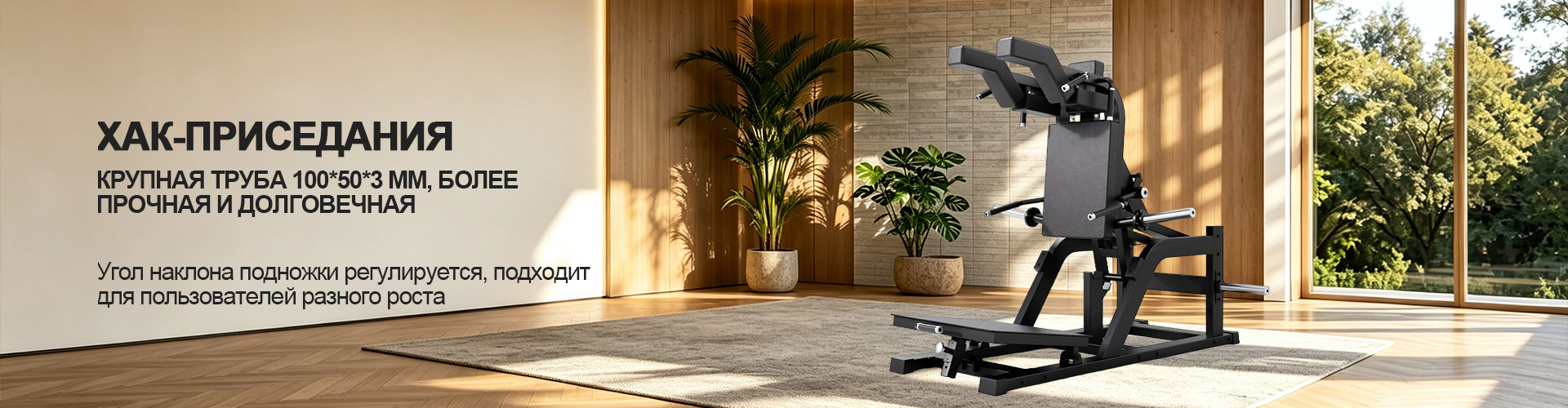
A key area of our activity is the production of strength training equipment under the brandKINGSTAR, as well as cardiovascular equipment, including commercial treadmills (model AC8000), elliptical trainers and spin bikes. Our range includes multifunctional systems and specialized plate-loading machines such as the HK046A (Standing Leg Extension), PL71A (Hack Squat) and HS055I (Smith Machine). We also offer solutions in ODM and OEM formats, allowing clients to implement individual projects based on their technical and design requirements.
The company's production base is equipped with two robotic welding lines, laser cutters, pipe bending machines and an electrostatic spraying line. This automation ensures high precision manufacturing and adherence to tight tolerances. Each product undergoes multi-level quality control (ISO 9001 certificate), including testing for cyclic loads and corrosion resistance. Our products are exported to more than 60 countries, and we are proud to help the fitness industry grow by providing reliable equipment and comprehensive service support.
Frequently Asked Questions
Can a home exercise bike be used in a small office fitness area?
Technically yes, but economically no. Even with a low load (5–10 people per day), a home model will fail 3–4 times faster than a commercial one. The cost of repairs and downtime will exceed the difference in purchase price. For offices, we recommend the entry-level commercial series (Light Commercial), which occupy an intermediate position in price and durability.
What certificate is required to import exercise bikes to Russia?
For legal sale and use for commercial purposes in the Russian Federation, a declaration of conformity of the CU TR (EAC) is required. It is also desirable to have a GOST R certificate confirming compliance with national safety standards. Our factory provides a full package of documents for customs clearance and certification.
Does the fan affect the noise level in the room?
Yes, but only slightly. Modern commercial fans are designed with aerodynamic blades that reduce turbulence. The main source of noise is not the air flow, but the mechanical parts. With proper maintenance (chain/belt lubrication, bearing checks), the noise level remains between 55-60 dB, which is comparable to the background noise of spoken language.
What is the average ROI for a commercial exercise bike?
With an average cost of a subscription and a simulator load of 4–6 hours a day, the payback period is 8–12 months. The key factor is the absence of breakdowns. Using quality commercial fan equipment reduces repair costs by 60-70% compared to residential equivalents, which directly increases the club's bottom line.
Choosing between a home and commercial model is a choice between short-term savings and long-term profits.Commercial Exercise Bike with Fanfrom a trusted factory is an investment in the reputation of your business and the safety of your customers. Don't risk quality for dubious savings.
Request a quote for commercial exercise bikes
Contact us today